Customize Your ResaleOS Settings: A Step-by-Step Guide
This guide provides a step-by-step process to customize your ResaleOS settings for profile, store details, branding, and more.
Customize your ResaleOS settings: a step‑by‑step guide
Use this guide to set up your account, defaults, branding, channels, and automations. You can do all of this from one place.
Step 1: Open Settings
In ResaleOS, click Settings in the left sidebar. You’ll see sections for Profile, Store, Defaults, Printing, Taxes, Notifications, Channels, Integrations, and Billing.
Tip: Click Save in any section before you leave it.
Step 2: Update your profile and contact info
- Go to Profile.
- Update your name and email.
- Add a phone number customers can use to reach you.
Tip: If your plan includes team access, add team members so each person has their own login.
Step 3: Add store details and locations
- Open Store.
- Enter your store name and website URL (if you have one).
- Click Add Location to create each store/warehouse address.
When you add or edit a product in Inventory, choose the correct location. Shipping rates and pickup calculations use this exact location.
Tip: Add all locations before you import or cross-list inventory.
Step 4: Set account defaults for consignments
- Open Defaults & Terms.
- Choose default payout methods and a default consigner split.
- Create and save consignment term templates you can reuse.
Note: You can override defaults on a per-consigner basis anytime.
Step 5: Choose item defaults
- In Item Defaults, set the default product status (e.g., Draft, Active) and condition (e.g., New, Used).
- Save. New items will prefill with these choices.
Step 6: Configure label printing
- Open Label Printing.
- Select your label size and printer format.
- Choose which fields show on the label (title, SKU, price, barcode, etc.).
- Preview and Save.
Tip: Match the label size to your printer (e.g., 2x1, 4x6). Print a test label before a full batch. For more detail, see the label printing guide.
Step 7: Set up taxes
- Open Taxes.
- Turn on automatic tax calculation to let ResaleOS calculate the correct rate at checkout based on your location and the buyer’s location.
- Add states/regions where you collect tax (nexus).
- Optional: Set a manual rate per sale if you prefer.
Tip: Tax rules vary. Confirm your nexus and rates with a tax professional.
Step 8: Customize receipts and branding
- Open Receipt Printing.
- Upload your logo and confirm your store info.
- Preview a sample receipt and Save.
Your logo and branding also appear in customer emails.
Step 9: Build pricing rules (automatic markdowns)
- Open Pricing Rules.
- Click Add Rule.
- Choose the schedule (e.g., every 7 days), the reduction (fixed amount or %), and the items it applies to.
- Save. Rules will run automatically.
Tip: Start with conservative markdowns. You can edit or pause rules anytime.
Step 10: Preview customer and consigner notifications
- Open Notifications.
- Select a template (sale confirmation, refund issued, consigner updates, etc.).
- Preview how the email looks to your customer or consigner.
Tip: Send a test to your own email to check branding and links.
Step 11: Connect your sales and import channels
- Open Channels.
- Click Connect next to eBay, Etsy, Poshmark, Mercari, Shopify, Facebook Marketplace, and more.
- Follow the prompts to authorize each account.
- Optional: Use Import to pull in your existing listings.
Tip: Connect all the marketplaces you sell on to enable cross-listing and centralized inventory.
Step 12: Add key integrations
- Open Integrations.
- Connect Stripe and/or Square for in-person and online payments.
- Set up shipping partners (UShip, GoShare, FedEx) for rates and labels that use your item locations.
Step 13: Manage your plan and billing
- Open Plan to review your current subscription and change plans if needed.
- Open Billing to update your payment method and view invoices.
Pro tips to finish strong
- Set locations and taxes first—these affect shipping and checkout.
- Use item and account defaults to save time on every new product and consigner.
- Preview labels, receipts, and emails before going live.
- Review pricing rules weekly to keep margins healthy.
Frequently asked questions
How do I update my profile in ResaleOS?
To update your profile, go to the Profile section in Settings and edit your name, email, and phone number.
What should I do before importing my inventory?
Make sure to add all store locations before importing or cross-listing your inventory to ensure accurate shipping calculations.
How can I set up automatic tax calculations?
Enable automatic tax calculation in the Taxes section to allow ResaleOS to calculate tax rates based on your and the buyer's location.
Can I customize my receipts in ResaleOS?
Yes, you can customize receipts by uploading your logo and confirming your store information in the Receipt Printing section.
What are pricing rules in ResaleOS?
Pricing rules allow you to set up automatic markdowns for your products based on specific conditions you define.
Related Articles
The register
How the point of sale works — cart, tenders, drawers & receipts
The whole register, in the order a sale moves through it: scanning and pricing the cart, tax and surcharges, split tender and change due, card readers, layaway and gift cards, then drawer counts, register lock and receipts.
Rose → ResaleOS
How to move from Rose (Consignor Connect) to ResaleOS
Free, done-for-you move from Rose to ResaleOS. Rose runs on Square, so you connect Square with one click and your items, photos and sales arrive on their own. Rose's Contract List brings every consignor, split and balance, and each item is linked back to its consignor. Live by lunch, with your Square register still ringing.
Website builder
How the ResaleOS website builder works
Build a real website around your ResaleOS shop — clone your old site, start from a template, or describe it to AI. Plus favicon, social sharing, SEO and search-engine verification.
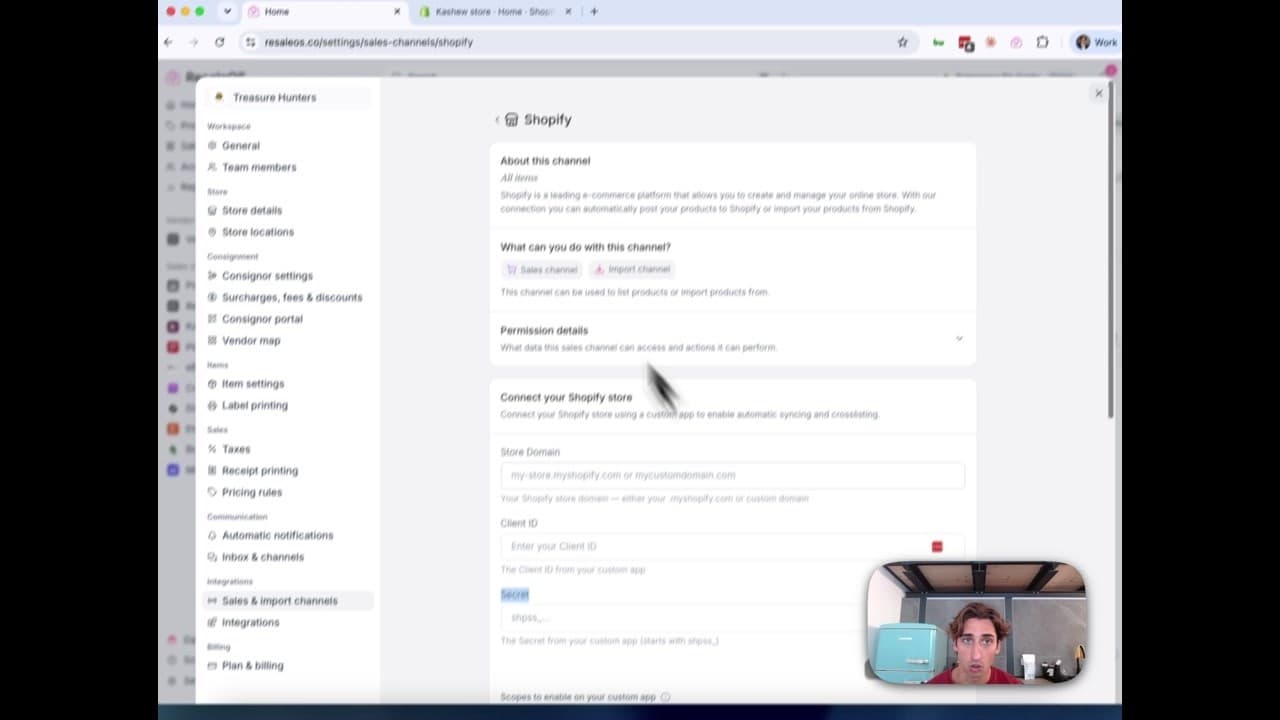
How to Connect Your Shopify Store to ResaleOS
Create a Shopify custom app, paste in the scopes ResaleOS gives you, and connect your store in a few minutes.
Print payout checks
How check printing works — bank accounts, templates & voucher stubs
Print consignor payout checks on pre-printed bank stock or blank security paper, with an itemised payout stub on the same sheet. Bank accounts and check numbering, the template editor, printing a batch, and tracking a check until it clears.
Vendoo → ResaleOS
How to move from Vendoo to ResaleOS
Moving from Vendoo takes about an hour, and nothing you have live gets re-listed or delisted. Connect the marketplaces you already sell on so your listings arrive with every photo, upload one export file from Vendoo for your drafts, labels and costs, and keep cross-listing from ResaleOS.
AI image editing
How image editing works — background removal, AI staging & batches
Remove backgrounds, add shadows, restage a product from a prompt, crop, colour-correct and watermark — on one photo or a whole batch. Which AI models run each job, what counts against your monthly photo edits, and how recipes replay your house style.
QuickBooks integration
How the QuickBooks integration works — sales, payables & payouts
Connect QuickBooks Online once and every sale, refund, consignor payable, payout and inventory movement books itself as the right kind of QuickBooks document. How to connect, what maps to what, and what deliberately does not sync.

Get started
Put what you've learned into practice. Start listing, managing inventory, and selling across channels today.