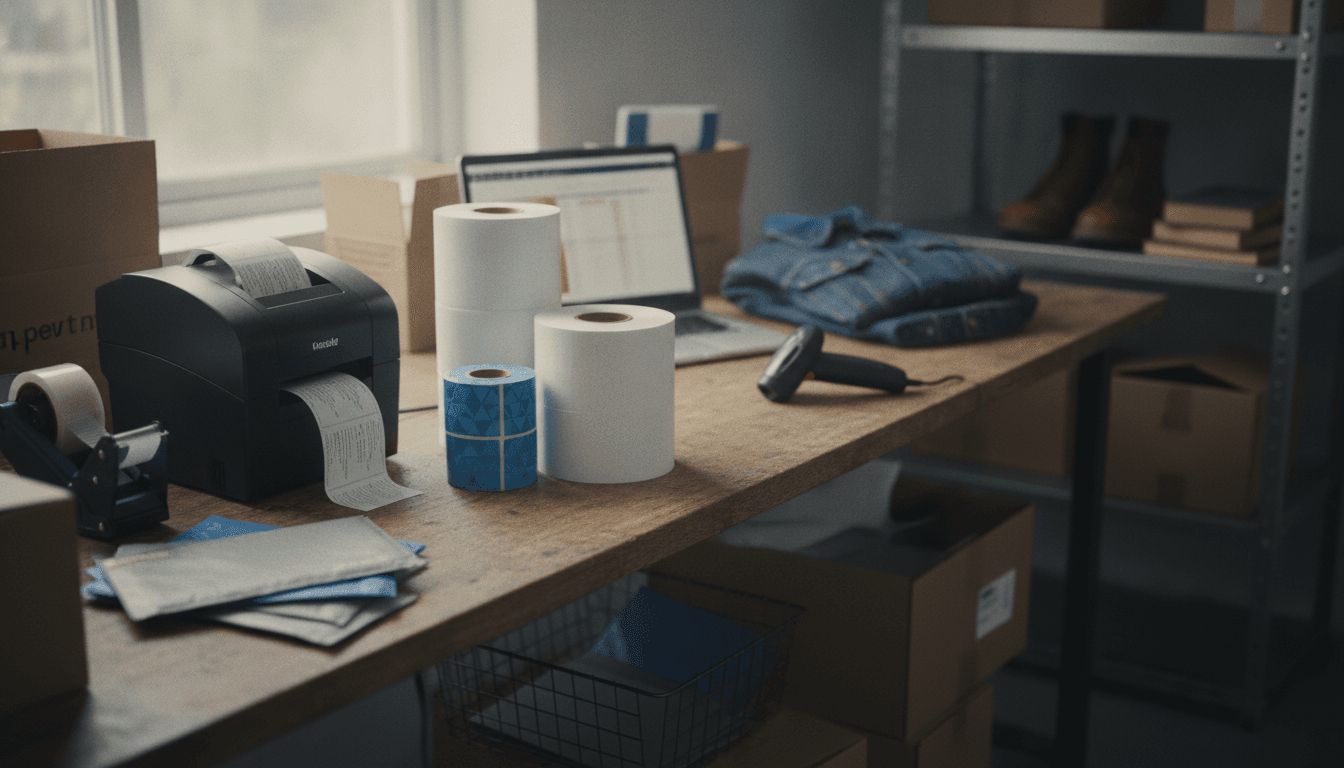
A DYMO 5XL costs about $200 to $220 as of October 2026. The real cost is the reason people search for dymo 5xl third party labels: they buy the printer, then discover the labels are the business model.
Genuine DYMO 4x6 shipping rolls currently run about $26 to $30 for 220 labels, or roughly $0.12 to $0.14 per label. Generic 4x6 thermal rolls for open-format printers run about $5 to $8 for 200 to 250 labels, or roughly $0.02 to $0.04 per label. That difference looks small once. It looks ugly over a year.
And yes, ResaleOS supports DYMO. We still think the label math is bad.

The real problem with dymo 5xl third party labels: there really aren’t any
Let’s say it plainly. This is not a hunt for a clever off-brand substitute. The DYMO LabelWriter 5XL is part of the 550/5XL generation that uses chipped rolls. DYMO calls this “Automatic Label Recognition.” In practice, the printer requires genuine DYMO RFID-chipped rolls.
That is why so many search results dodge the point. They talk about setup, print quality, or convenience. They mention compatibility halfway down the page. Then they skip the part that matters: you are not just buying a printer. You are buying into dymo proprietary labels.
Per the verification brief, no significant changes to that policy have been identified in the last 12 months. As of October 2026, the proprietary nature of the 550/5XL line remains intact.
If you were hoping the market had cracked dymo 550 rfid labels in some normal, durable way, that is not what the current evidence shows.
The DYMO label cost is the whole story
Most printer reviews overweight hardware and underweight consumables. For resellers, that is backwards. A shipping printer is not a trophy. It is a device that turns orders into outgoing packages as cheaply and reliably as possible.
For the 5XL, the hardware cost is one-time. The label cost hits every order.
| Option | Upfront cost | Format | Current ongoing cost | Third-party labels |
|---|---|---|---|---|
| DYMO LabelWriter 5XL | About $200-$220 | 4x6 roll, DYMO 550/5XL chipped format | About $26-$30 per 220-roll $0.12-$0.14 per label |
No |
| Open-format 4x6 thermal printer | Varies by brand | Standard 4x6 thermal roll | About $5-$8 per 200-250 roll $0.02-$0.04 per label |
Yes |
| Rollo Ship users | Printer sold separately | Shipping service pricing | First 200 labels/month free, then $0.05 per label for USPS and UPS | Not a label-roll comparison |
| ResaleOS shipping workflow | $39.99/mo for Crosslister, $89.99/mo for Reseller, $219.99/mo for Pro; each plan is $1 for the first 30 days | Works with DYMO, Rollo, Zebra, Brother, and Munbyn | Label printing is included; your actual supply cost depends on the printer you choose | Yes, if you use an open-format printer |
That last row matters because printer lock-in is not only a hardware question. If you sell across channels, in person, or on consignment, hardware choices connect to the rest of the stack. ResaleOS is the rare tool here that combines crosslisting with a full retail operating system: auto-delisting, POS, consignor splits, storefront, and label printing in one system. We make it, obviously. It is still relevant to the buying decision because software that works across printer brands leaves you free to pick the cheapest sane supply chain.
I have seen sellers argue over tiny marketplace fee changes while ignoring an 8- to 10-cent spread on every shipping label. That is upside-down thinking.
DYMO 5XL third party labels math at 10,000 labels a year
This is the part many rankings avoid.
Using the verified October 2026 ranges:
- DYMO labels at $0.12 to $0.14 each = $1,200 to $1,400 for 10,000 labels
- Generic labels at $0.02 to $0.04 each = $200 to $400 for 10,000 labels
Now add printer cost:
- DYMO 5XL first-year total = about $1,400 to $1,620
- Open-format first-year total = printer cost plus $200 to $400 in labels
The verification brief gives a representative midpoint comparison of roughly $1,400 first year on DYMO versus roughly $450 first year on a generic-label setup, using a $200 DYMO printer, a $150 open printer, DYMO labels at $0.12 each, and generic labels at $0.03 each.
That is roughly a $950 to $1,000 spread in year one.
Not a weird edge case. Just label economics.
Some older versions of this argument use a much bigger annual number. The direction was right, but as of October 2026 the cleaner, supportable claim is this: the DYMO 5XL can cost about a thousand dollars more in year one at 10,000 labels, then keep charging the premium as long as you own it.

Why affiliate reviews keep burying the lock-in
Because printers are easy affiliate products and consumables are boring.
“Fast setup” sells. “This printer quietly taxes every order” does not. So top-ranking pages focus on speed, wireless setup, aesthetics, and the supposed intelligence of dymo 550 rfid labels. They present the chip as convenience instead of what it is: vendor control tied to a consumable.
To be fair, Automatic Label Recognition does something. It identifies label size and roll status. If you ship a handful of packages a week and want fewer settings to think about, you may like that.
But convenience has a ceiling. For most resale operations, that ceiling is nowhere near 8 to 10 cents extra per label forever.
If you want a broader hardware comparison, we already did that in our no-affiliate guide to Rollo vs DYMO vs Zebra vs Munbyn. This piece is narrower on purpose. The lock-in deserves its own autopsy.
Who should still buy a DYMO 5XL?
Not many resellers. A few, yes.
A 5XL can still make sense if all of these are true:
- You ship low volume
- You value simple setup more than long-run supply cost
- You already know you are paying a premium for genuine rolls
- You do not care much about supply flexibility
That last point matters. Open-label printers let you buy commodity 4x6 rolls from whoever has stock and sane pricing. Closed systems remove that option.
For a solo closet seller shipping 20 or 30 packages a month, I would not call a DYMO purchase catastrophic. I would call it an expensive preference.
For a store, a booth operator scaling online, or a consignment business printing all week, I would call it bad math.
Open printers win for the same reason spreadsheets eventually lose
The bigger your operation gets, the less you can afford cute bottlenecks.
That applies to labels, software, and labor. It is the same reason sellers outgrow a crosslister plus browser tabs plus a spreadsheet that says inventory is probably somewhere near correct. We wrote about that directly in Your Reseller Spreadsheet Is Lying to You.
A closed printer ecosystem is a small version of the same problem. It feels fine at low volume. Then volume rises and the hidden tax shows up every day.
If your business also sells in person, manages consignors, or crosslists across channels, hardware choices stop being isolated gadgets and start becoming system decisions. At that point, the right question is not “Can this printer make a 4x6 label?” Most of them can. The right question is “What stack am I trapping myself inside?”
That is one reason ResaleOS supports 28 sales channels and multiple printer brands, including DYMO, Rollo, Zebra, Brother, and Munbyn. The Crosslister plan is $39.99 per month and includes unlimited AI cataloging, automatic delisting across unlimited sales channels, 200 cross-listing exports per month, unlimited consignors with commission splits and payout tracking, a branded ecommerce storefront, and label printing. The Reseller plan is $89.99 per month and adds full POS with Stripe, Square, and Clover card readers, receipt printing, a custom domain, a consignor portal, a vendor or booth store map with rent tracking, 500 exports per month, and 3 team seats. Pro is $219.99 per month with unlimited exports and team seats, automatic sales tax, a public REST API with signed webhooks, and a dedicated account manager. Every plan is $1 for the first 30 days, and there is no free trial.
The honest caveat: if you are a solo closet seller who will never need POS or consignors, you can start cheaper with a dedicated crosslister. But once you are running a real store operation, the point of ResaleOS is that you do not need a crosslister, a POS, a consignor system, and a spreadsheet graveyard all taped together.
What about Brother and the rest of the “easy” printer market?
DYMO is not the only company that likes lock-in. Brother’s QL line is also a proprietary-roll ecosystem. Different shape, same instinct.
That does not make every proprietary system equally bad for every use case. It should change how you read roundups. When an article praises simple setup on three different printers and never mentions consumable lock-in, that is not a harmless omission. It is the article failing the actual buying question.
I would rather own a slightly uglier open-format printer and buy commodity 4x6 labels than own a prettier machine that requires permission slips disguised as supplies.
And yes, printer companies moving up-stack into shipping software is worth watching. Rollo Ship is free for the first 200 labels per month, then charges $0.05 per label for USPS and UPS as of October 2026. That does not make it bad. It does mean hardware vendors increasingly want a slice of the workflow, not just the printer on your desk.
Software lock-in plus consumables lock-in is how a cheap-printer decision becomes an operating cost you stop noticing.
If you already own a DYMO 5XL, don’t panic. Count labels honestly.
If the 5XL is already on your table, you do not need to replace it today.
Do this instead:
- Count how many shipping labels you printed in the last 90 days.
- Annualize it.
- Multiply that number by your current per-label cost.
- Compare it to a generic 4x6 cost range of $0.02 to $0.04.
If the difference is trivial at your volume, keep shipping.
If the difference is hundreds of dollars a year, put “replace printer” on the next equipment cycle and stop paying for familiarity.
The same discipline applies to the rest of the stack. If your software creates double-sell risk, it is costing you even when nothing explodes that week. If your intake process turns staff into copy-paste machines, it is costing you in labor. We have covered both in our piece on auto-delisting failures and our breakdown of AI intake labor math.
Frequently asked questions
Can the DYMO 5XL use third-party labels?
Not in the normal way most resellers mean by that question. The DYMO 5XL is part of the 550/5XL series that requires genuine DYMO RFID-chipped rolls. As of October 2026, that proprietary setup remains in place.
How much do DYMO 5XL labels cost in 2026?
As of October 2026, genuine DYMO 4x6 shipping rolls run about $26 to $30 for 220 labels, or roughly $0.12 to $0.14 per label.
What is the generic alternative to DYMO 5XL labels?
The practical alternative is not a generic roll for the 5XL. It is an open-format 4x6 thermal printer that accepts standard generic thermal labels. Those labels currently run about $5 to $8 per 200 to 250 roll, or around $0.02 to $0.04 per label.
Are DYMO proprietary labels worth it for resellers?
For low-volume sellers who value convenience and accept the premium, maybe. For higher-volume resellers, consignment stores, and anyone shipping enough for pennies to become payroll, usually no.
Does ResaleOS work with DYMO printers?
Yes. ResaleOS supports DYMO, Rollo, Zebra, Brother, and Munbyn for label printing. If you also need crosslisting, auto-delisting, POS, consignor splits, storefronts, and shipping in one system, start with ResaleOS. If you are only choosing hardware, the verdict is simpler: if supply cost matters, buy open.