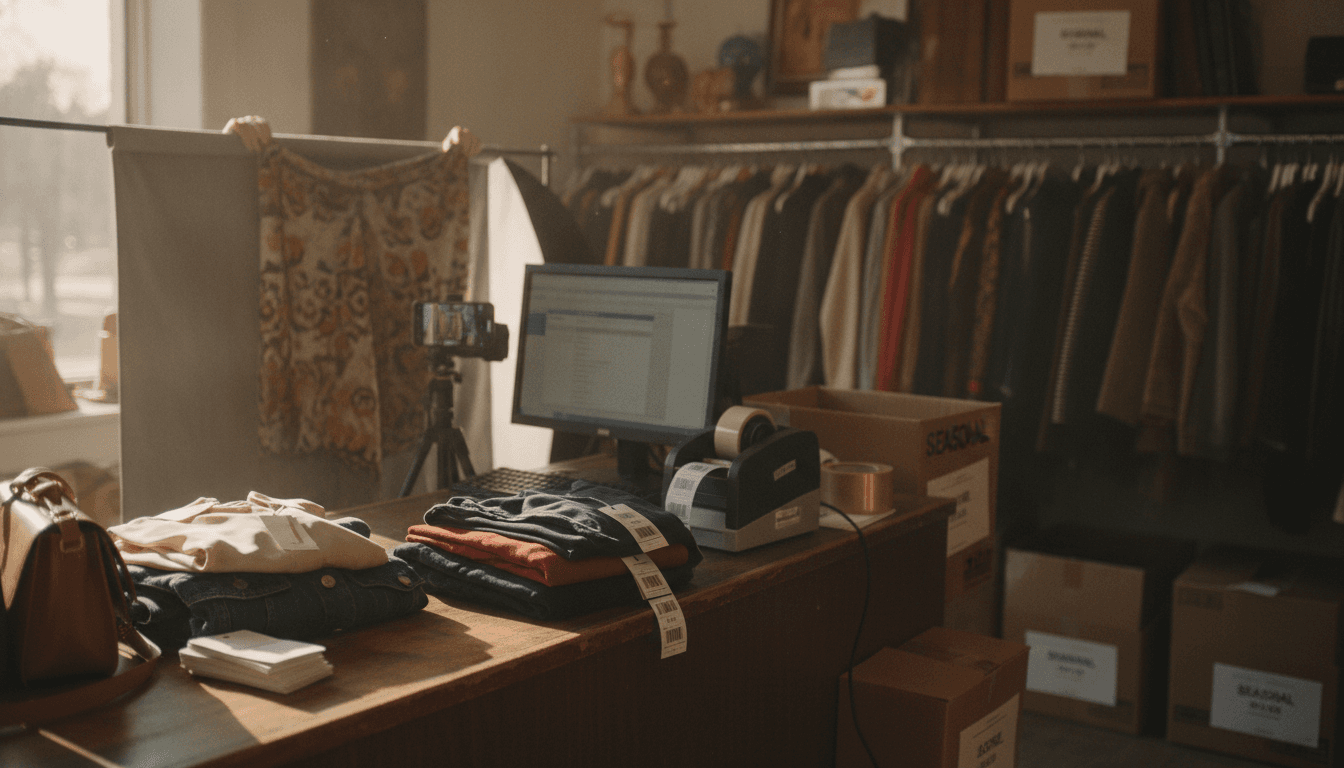
A store owner with 1,300 consignors described intake as “gross basement data entry” and said photo-AI cut input time roughly in half. I believe it. Consignment inventory intake AI is solving the ugliest part of the job, not the glamorous part. Not selling. Not merchandising. Typing.
That matters because intake labor compounds fast. Five extra minutes per item does not feel like much at the counter. It becomes a payroll line when you multiply it across intake days, piles of women’s denim with half-faded size tags, and the sixth “no brand but expensive-looking” tote of the morning.
The market has moved. Circle-Hand now sells AI-assisted intake and pricing starting at $83/month on annual billing or $99/month month-to-month, as of October 2026. SimpleConsign includes AI item entry in its $359/month Professional plan, and also offers a $99/month Store Launch Program until $75,000 in revenue. Aravenda markets AI Item Entry too. Everybody has the pitch.
What nobody publishes is the part operators actually need: accuracy rates, miss patterns, and when AI item entry saves time versus when it creates clean-looking junk data you pay to fix later.
Consignment inventory intake AI is a labor tool first
If you run a consignment store, your intake bottleneck is usually one of three things:
- photo capture
- consignment data entry
- pricing and tagging
Photo-AI only attacks the middle and part of the third. That is still a big deal because data entry is where good staff go to die a little. They are doing repetitive recall work on categories that do not deserve human genius: mall-brand tops, standard home decor, common kids’ gear.
The wrong question is “Can AI replace staff?” No. On vintage or weird merchandise, you would not want it to.
The right question is: How many staff minutes can you stop spending on first-draft cataloging?
That includes generating:
- title
- description
- category
- brand
- condition notes
- dimensions, when the system supports them from photos
ResaleOS does this with AI cataloging from photos: photo to title, description, category, brand, condition, and dimensions, then into the rest of your workflow. We make it, judge accordingly. The practical point is simpler than the pitch: if your staff is still hand-keying every “Madewell women’s blue skinny jeans size 28 good used condition,” you are spending real money to recreate information a model can draft in seconds.

The labor math on AI item entry consignment workflows
Think about this the way owners actually do: time per item, times items per intake day, times intake days per month.
We do not have published platform accuracy studies, and I am not going to fake throughput numbers and call it research. You do not need fake precision to see the shape of the problem.
A manual intake flow commonly includes:
- photograph item
- identify category and brand
- write a title
- write a usable description
- add condition notes
- price it
- print or assign tag/barcode
An AI-assisted intake flow still needs a human, but that human is editing a draft instead of starting from zero.
| Workflow | What staff does | Where time goes | Main risk |
|---|---|---|---|
| Manual intake | Creates every field from scratch | Typing, category decisions, repetitive descriptions | Slow throughput and inconsistent records |
| AI-assisted intake | Photographs, reviews, corrects, prices | Review and exception handling | Bad drafts on vintage, niche, or unbranded goods |
| Over-automated intake | Trusts AI too much | Back-end cleanup after bad catalog data | Fast wrong data, which is worse than slow right data |
The “cut in half” claim rings true because first-draft text is a lot of the drag. If your team can turn manual entry into review-and-correct, even modest per-item savings become meaningful over a month.
Ten items, who cares. Two hundred intake pieces on a busy buying week, you care. Five hundred, you definitely care.
This is the same problem as a death pile, just wearing nicer clothes: small per-item friction turns into a cash-flow problem at scale. We made that case in Death Piles Are a Cash-Flow Problem, Not a Character Flaw, and intake backlog is the consignment-store version.
Where consignment inventory intake AI actually breaks
This is the section most vendor posts avoid because it makes demos look worse.
AI item entry consignment tools are best on ordinary, legible, recent, branded inventory. They are weakest where the margin is often best or the judgment matters most.
1. Vintage with obsolete language
Older garments and housewares use category cues, fabric blends, era markers, and brand labels that do not map neatly to current retail taxonomy. AI can describe the object while missing the reason it matters.
A 1990s rayon novelty blouse is not just “women’s button-front shirt multicolor.” That draft is technically acceptable and commercially lazy.
2. Unbranded or private-label goods
When there is no strong label signal, AI tends to produce generic titles and broad categories. That may be good enough for in-store tagging. It is weaker for online listing where search precision matters.
3. Collectibles and niche categories
Decor, art, ephemera, tools, and specialty hobby items often need comp-aware judgment, not object recognition alone. AI can help with structure, but not authority.
4. Condition nuance
“Good used condition” is the industry’s default shrug. Buyers want specifics: heel drag, pinhole, crazing, repaired seam, tarnish, missing insert, nonworking zipper. AI can miss subtle defects or smooth them into bland copy.
5. Dimensions that actually matter
Even when software can infer dimensions from photos, stores should still sanity-check measurements on categories where fit or freight cost rides on inches. Furniture is unforgiving. So are men’s tailored garments, lamps, and framed art.
This is why no serious operator should ask, “Is the AI accurate?” The better question is, accurate on what, and wrong how?

What software costs if you want AI intake now
AI intake is becoming table stakes. The pricing is still all over the place.
| Platform | Starting price | AI intake status | Notable catch |
|---|---|---|---|
| ResaleOS | $39.99/month for Crosslister, $89.99/month for Reseller, $219.99/month for Pro; every plan is $1 for the first 30 days | Unlimited AI cataloging on every plan | No free trial; card required at signup. Best fit if you also want crosslisting, consignor splits, storefront, shipping, and possibly POS in one system. |
| Circle-Hand | $83/month yearly or $99/month monthly, as of October 2026 | Includes AI-assisted item intake and pricing | Strong value pitch; no extra fees for Shopify integration or setup, based on current public comparison pages |
| SimpleConsign | $159/month Basic, $259/month Standard, $359/month Professional, as of October 2026 | AI item entry included in Professional | Store Launch Program offers Professional-tier features at $99/month until $75,000 in revenue |
| Aravenda | $159/month Not For Profit, $269/month Consignment Shop, $379/month Professional, as of October 2026 | AI Item Entry available | Access may depend on package; Aravenda’s public pricing presentation is less clear than it should be |
| ConsignCloud | $139/month Basic, $189/month Pro, as of October 2026 | No verified AI intake detail in this brief | Included because shoppers compare it often; do not assume AI parity from market noise |
| Ricochet | $99/month Core, $149/month Reach, $199/month Lead, as of October 2026 | No verified AI intake detail in this brief | $100/month non-integrated processing fee if you do not use Ricochet Pay, effective May 1, 2026 |
A blunt read of this table: if your only criterion is AI listing software for stores at the lowest monthly cost, Circle-Hand deserves the attention it is getting.
But software decisions in consignment rarely stay single-feature decisions for long. The stack creeps. First you want intake help. Then consignor payouts. Then a branded site. Then in-store checkout. Then your online channels need auto-delisting so you do not double-sell the same handbag. We covered that failure mode in Crosslisting for Consignment Stores Has Different Failure Modes and in The Auto-Delist Problem.
That is the real case for ResaleOS. Not “we have AI too.” Everyone says that now. It is that ResaleOS is the only tool in this slice of the market combining crosslisting with a full retail operating system: consignor splits and payout tracking, a branded storefront, shipping and label printing, hardware support, and on the Reseller plan and up, full POS. If you are scaling past a closet or running any operation that sells both online and in person, one system beats a crosslister plus POS plus spreadsheet stack. Bias disclosed; still true.
How to test consignment inventory intake AI before you trust it
If a vendor says “save hours” but cannot tell you where the tool fails, run your own bake-off.
Test with a 30-item intake batch split like this:
- 10 straightforward branded basics
- 10 unbranded or weakly labeled items
- 10 vintage, niche, or condition-sensitive items
For each item, review:
- brand accuracy
- category accuracy
- title usefulness
- condition detail quality
- how much editing a staff member had to do before the record was floor-ready
You are not looking for perfection. You are looking for edit distance. How far is the draft from usable?
That is the metric nobody publishes, and it is the one that matters for payroll.
Also test the output where it hurts to be wrong:
- items with no RN number, style code, or visible brand
- items with unusual silhouettes or era-specific names
- home goods with pattern names or maker marks
- items where one flaw changes price materially
If the AI gets your easy 80% close enough and your staff can catch the ugly 20%, that is a workable system. If it writes pleasant nonsense that needs a human rewrite, you did not buy speed. You bought another review step.
If intake time gets cut in half, reorganize labor
This is the part I feel strongest about.
If photo-AI really cuts your input time roughly in half, the biggest mistake is treating that as a nice convenience and leaving your workflow alone.
Do not bank the savings invisibly. Reassign it.
Move that labor into the tasks machines still do poorly and stores chronically underfund:
- better pricing review
- condition inspection
- merchandising
- faster floor turns
- online crosslisting for the top slice of inventory
- consignor communication
Manual intake is low-value labor pretending to be unavoidable overhead. It is not. Once software drafts the boring fields, the human part of intake should get more selective and more commercial.
This is especially true in stores sitting on large consignor counts. A 1,300-consignor operation does not need prettier copy. It needs throughput, consistency, and fewer staff hours disappearing into repetitive keyboard work.
And if you are crosslisting the better items online, that labor shift matters twice. Every minute not wasted on typing a generic title can go into channel choice, pricing strategy, and delisting control. For store owners selling across marketplaces, the supported-platform list is the practical question, not the marketing one. ResaleOS supports 28 sales channels including eBay, Etsy, Poshmark, Mercari, Depop, Whatnot, Chairish, Vinted, Vestiaire Collective, StockX, GOAT, Shopify, WooCommerce, Wix, Square, Facebook Marketplace, and Kashew.
What a good AI item entry consignment setup looks like
The best setup is boring. Good.
- Staff photographs the item in a consistent way.
- The system drafts the item record.
- Staff corrects brand, category, condition, and price where needed.
- Tag prints immediately.
- The item is floor-ready and, for selected inventory, online-ready.
The software should reduce keystrokes and duplicate work. It should not force you to do intake once for the floor and then again for ecommerce. That is where a lot of stores quietly bleed labor.
ResaleOS is built around that operational handoff: AI cataloging from photos, unlimited consignors with commission splits and payout tracking, a branded ecommerce storefront, label printing support for DYMO, Rollo, Zebra, Brother, and Munbyn, shipping from USPS, UPS, and FedEx through freight and white-glove, and, on the Reseller plan, in-person checkout through Stripe, Square, or Clover. If you are shopping label hardware too, our guide to Rollo vs DYMO vs Zebra vs Munbyn pairs well with this discussion because intake speed dies fast when printing is fussy.
Honest caveat: if you are a solo closet seller doing low volume and you will never need POS or consignor management, a dedicated crosslister can be the cheaper starting point. But that stops being true quickly once you add staff, in-store sales, or consignor payouts.
Frequently asked questions
Does consignment inventory intake AI actually save enough time to matter?
Yes, if your bottleneck is drafting item records from scratch. The real gain is not magic pricing or perfect titles. It is shifting staff from blank-page typing to review-and-correct work. At store volume, that labor difference compounds quickly.
What items are hardest for AI item entry consignment tools?
Vintage, unbranded inventory, collectibles, and condition-sensitive goods are the main trouble spots. Those categories rely on nuanced labeling, era knowledge, or defect detail that generic AI drafts often flatten.
Which consignment software includes AI intake?
As of October 2026, Circle-Hand includes AI-assisted intake and pricing starting at $83/month yearly or $99/month monthly. SimpleConsign includes AI item entry in its $359/month Professional plan, with a $99/month Store Launch Program until $75,000 in revenue. Aravenda markets AI Item Entry. ResaleOS includes unlimited AI cataloging on every plan, starting at $39.99/month, with every plan $1 for the first 30 days.
Should I trust AI pricing during intake?
Trust it as a starting point, not as authority. For ordinary goods, it can speed first-pass pricing. For unusual, collectible, luxury, or high-condition-sensitivity items, staff judgment still carries the margin.
How should a store test AI listing software for stores before switching?
Run a mixed 30-item batch and score how much human editing each record needs before it is ready for the floor or online listing. “Usable draft with minor fixes” is success. “Pleasant-looking rewrite job” is not. Consignment intake has always been sold as an inventory problem. It is a labor problem first. Once you see that, AI stops being a novelty and starts being a staffing decision. If you want one system that handles AI cataloging, crosslisting, consignor splits, storefront, shipping, and POS instead of bolting those together piece by piece, that is where ResaleOS fits. If the next question is channel coverage, see every platform ResaleOS supports.