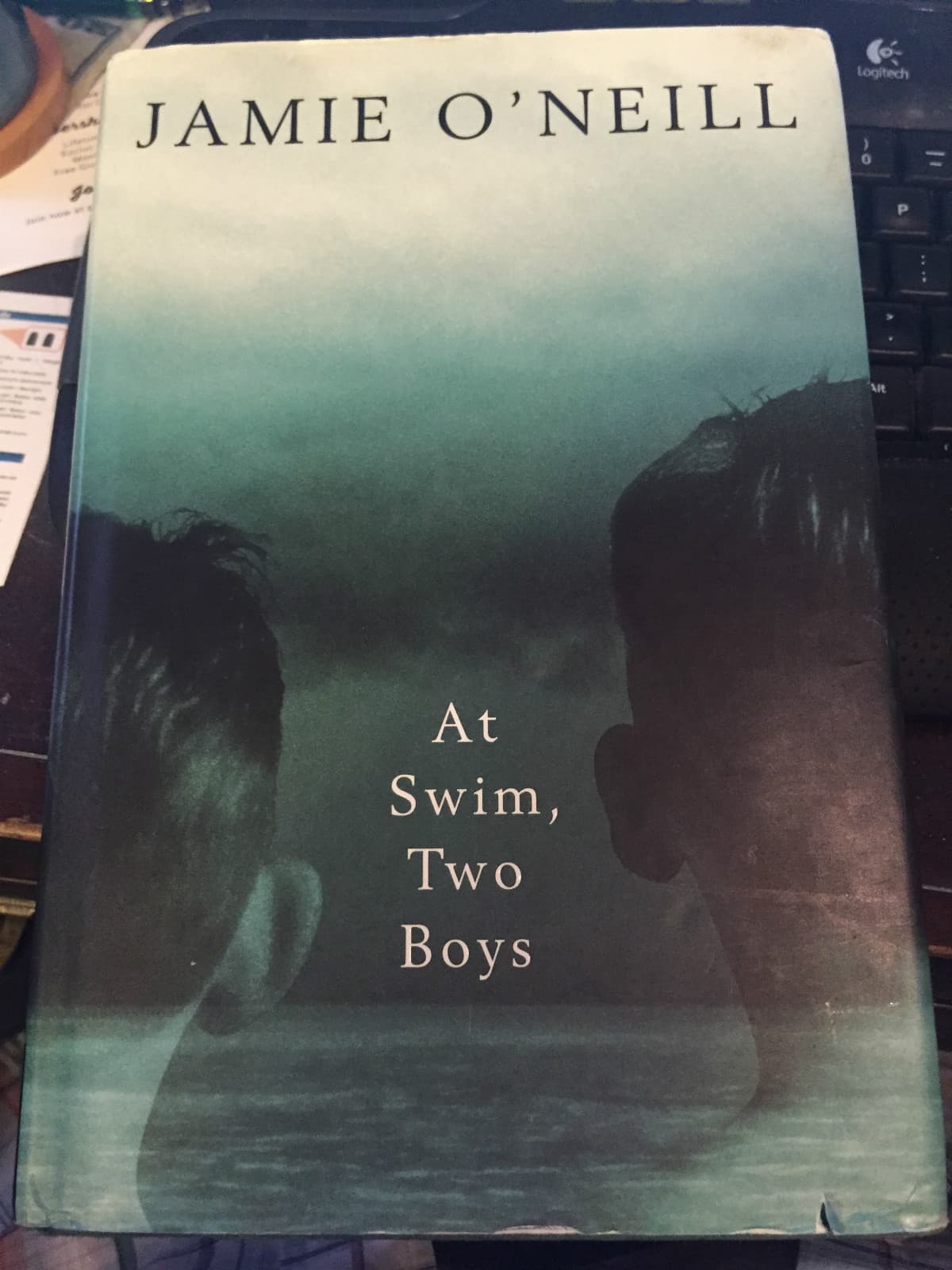
At Swim, Two Boys 1st edition British hardcover
 |
Let's start off by saying this book may not be for everyone--but it should be. I'm not referring here to the fact that its three lead characters are gay, since "At Swim, Two Boys" is so much more than "a gay novel" and since, while often sensuous, it is hardly erotic. Instead, the efforts of many readers may be thwarted by O'Neill's challenging and lyrical prose, the Irish brogue and street slang, the invented Latin derivations and oh-so-clever puns. After 50 to 75 pages, though, the reader's patience is well rewarded. Once you accustom yourself to the pattern of the prose, the context provides clues to even the most unfamiliar words, and I found the book difficult to set aside. (A little advice: after you pick up the cadence of the dialect, you may well want to go back and read those beginning pages again. The second time around revealed some wonderful passages and pivotal characterizations that flew right over my head initially.)
Set during the year prior to the Easter Rising in 1916, the novel focuses on two 16-year-old boys, Doyler and Jim, and their families. The main characters are finely portrayed, and (as others have noted) they successfully arouse the reader's sympathies. But O'Neill adds a memorable supporting cast: Jim's aunt, a doddering, whiskered crone who always seems far more aware of what's going on than one is led to believe; Eva MacMurrough, a rich patron of Irish rebel causes who is flustered by her nephew's Wildean tendencies; and, for comic relief, Jim's father, a pretentious wannabe who always manages to be in exactly the wrong place at the wrong time.
The most nuanced portrayal is that of the Anthony MacMurrough. Once may quibble over whether he is a pedophile: textual clues place his age in his early- to mid-20s; Doyler, his "rent boy," is 16. (If he were straight, such a relationship would be lawful and accepted in many states and most countries.) Legality aside, though, one cannot deny he is a sexual predator, and it's difficult not to detest his narcissism and self-rationalizing hedonism. But, as the novel progresses (and here I am necessarily vague in order not to give anything away), he gradually and subtly realizes that such encounters are not the road to happiness. He ultimately redeems himself, learning to find fulfillment by sharing his love rather than taking his way. But to claim that MacMurrough is a "mentor" to Doyler and Jim misses the point: he learns far more from the boys than they learn from him.
A lesser author would be foolish to tackle so much: Irish nationalism, sexual orientation, Catholic guilt, alcoholism, class identity, unwed pregnancy, unionism and socialism, the burden of tradition, Joyce and Wilde and Flann O'Brien. O'Neill's success is his enviable ability to weave together all these topics so seamlessly while fashioning a unique and lyrical voice and spinning a page-turning, heartbreaking yarn.
shipping IN USA
|
|
|